
DQ381 Gearbox: Technology, Problems and the Right Replacement
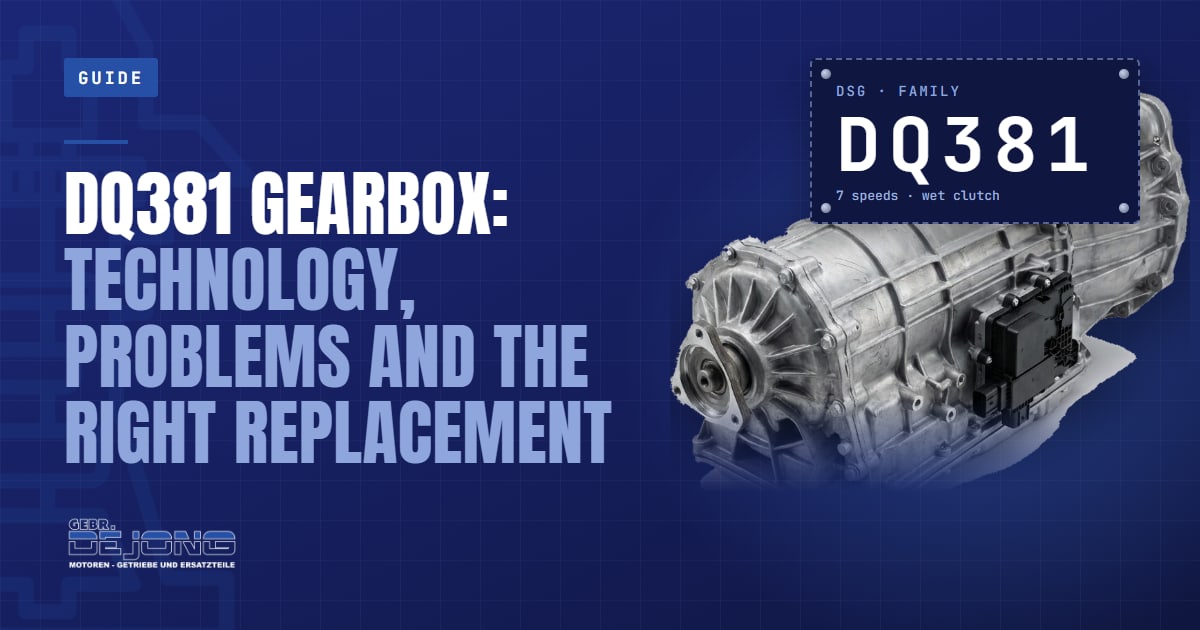
The DQ381 gearbox is the Volkswagen Group's wet 7-speed DSG. Where it is fitted, common problems, maintenance and how to find the right replacement using the gearbox code.
The DQ381 gearbox is a 7-speed dual-clutch transmission (DSG) from the Volkswagen Group with two wet clutches running in oil, also known by the type code 0GC. It is mainly fitted to cars with the stronger 2.0 TDI and 2.0 TSI engines from VW, Audi, Skoda and Seat. If you need a replacement, the gearbox code is what counts: the variants within the DQ381 family are not interchangeable.
What is the DQ381 gearbox?
The DQ381 is part of Volkswagen's DSG family. Like every DSG it uses two sub-gearboxes: one clutch handles the odd gears, the other the even gears. The next gear is already preselected, so shifts are fast with no noticeable loss of drive. Everything is controlled by the mechatronic unit, a combined control module and hydraulic block mounted on the gearbox.
Unlike the smaller DQ200, the DQ381 has wet clutches: the clutch plates run in gearbox oil, which cools them and also acts as hydraulic fluid for the mechatronics. That allows the gearbox to handle more torque. In many applications the DQ381 replaced the 6-speed DQ250. There is a front-wheel-drive version and an all-wheel-drive version (4Motion or quattro).
Which vehicles use the DQ381?
The DQ381 is typically paired with more powerful engines, usually 2.0 TDI diesels and 2.0 TSI/TFSI petrol engines. Which variant is fitted depends on the model, the engine and the drivetrain. Gearboxes in our stock come from vehicles such as:
- VW: Golf Mk7 and Mk8 (GTI, GTD, 2.0 TDI), Tiguan, Passat, T-Roc, Touran, Caddy, Polo 2.0 TDI, Multivan T7
- Skoda: Octavia, Superb (including 4x4), Karoq
- Seat: Ateca
- Audi: S3 2.0 TFSI
This is only a selection. The only reliable way to know whether your car has a DQ381 is the gearbox code, not the model name.
Common DQ381 gearbox problems
The DQ381 is generally seen as more robust than some older DSG generations. Even so, workshops and owner forums regularly report similar complaints:
- Judder or vibration when pulling away and at low revs
- Delayed or harsh shifts, often linked to the mechatronic unit
- Warning messages and limp mode, for example after heavy load or with hydraulic pressure issues
- Clutch slip: revs rise under acceleration but the car does not pull accordingly
- Oil leaks at the gearbox housing
Old or contaminated oil is a frequent factor. Because the oil cools the clutches and feeds the mechatronics, wear particles and deposits can affect the valves. Only a diagnosis with a scan tool reveals the actual cause. Not every judder means the gearbox has failed. Sometimes the shift quality improves after an oil change followed by clutch adaptation. If, however, the clutch packs are worn, the mechatronic unit has failed or bearings and gears are damaged, the repair becomes extensive. For symptoms and options, see our guide to DSG gearbox problems.
Maintenance: oil and filter changes
For the DQ381, an oil change with a new oil filter is the key maintenance item. The interval is set by the vehicle manufacturer for each model. Many specialist workshops recommend shorter intervals, especially for towing, lots of short trips, spirited driving or a tuned engine.
- Use only the DSG fluid approved by the manufacturer
- Check the oil level at the specified temperature
- After the oil change, run the clutch adaptation (basic setting) with a diagnostic tool
- Read the fault memory before small issues become big ones
Finding the right DQ381 replacement: the gearbox code decides
"DQ381" only describes the gearbox family. Within it there are many variants, each with its own gearbox code, for example WFS, VCY, TGB or UAR. They differ in gear ratios, drivetrain (front or all-wheel drive) and calibration for the engine. A gearbox with a different code will usually not fit, even if it looks identical.
You will find the code on the vehicle data sticker in the service book or in the spare wheel well, and on the gearbox housing. Our guide on finding your engine and gearbox code explains how.
| Check | What to look for |
|---|---|
| Gearbox code | must match the old gearbox |
| Drivetrain | front-wheel drive or all-wheel drive (4Motion, quattro, 4x4) |
| Engine | diesel or petrol, power output and engine code |
| Part number | extra cross-check where available (often starts with 0GC) |
In our shop you can search directly by code, for example WFS, VCY or TGB. All variants are listed in the DQ381 gearbox category.
Buying a used or remanufactured DQ381
A used or remanufactured gearbox is often a sensible alternative to a repair. Keep these points in mind:
- Check the code: exactly the same variant as your old gearbox.
- Condition and mileage: each listing states whether the unit is new, used or remanufactured. Remanufactured means professionally stripped, cleaned, wear parts replaced and then tested.
- Clarify what is included: if in doubt, ask which ancillary parts come with it.
- Warranty: 12 months on used and remanufactured parts, 24 months on new parts, with no mileage limit.
- Core deposit: usually €250 for gearboxes. It is refunded in full once the matching, complete old gearbox has arrived and been checked.
Whether a repair or a replacement works out cheaper depends on the damage, the condition and mileage of the replacement unit, the labour hours and any extra parts needed. Ask your workshop to price up both options.
Have the gearbox fitted by a workshop and follow the manufacturer's instructions: fresh oil, clutch adaptation, fault memory check. That keeps the warranty fully valid. Every gearbox is checked before dispatch and delivered on a pallet by freight carrier, usually within 3–7 working days.
Need help finding your DQ381?
Not sure which DQ381 fits your vehicle? Call us on +49 4950 93890 (Mon–Fri 8:30–12:30 and 13:30–17:30) or email info@motoren-dejong.de, ideally with the gearbox code or VIN. You will find other gearbox families under our VW gearboxes and Audi gearboxes.
Frequently asked questions
Is the DQ381 the same as the DQ500?
No. Both are wet 7-speed DSG gearboxes from the Volkswagen Group, but the DQ500 is designed for higher torque and larger vehicles. They are not interchangeable.
Can I fit a front-wheel-drive DQ381 to an all-wheel-drive car?
No. Front-wheel and all-wheel-drive variants are built differently and have their own gearbox codes. Always go by the code of your existing gearbox.
Does anything need setting up after fitting a used DQ381?
Yes. The workshop should check the oil, run the clutch adaptation with a diagnostic tool and read the fault memory. This is part of a proper installation.
Where do I find the part number of my DQ381?
The part number is usually on a label or plate on the gearbox housing. It supports the gearbox code but does not replace it.
Search directly by your code
Enter the engine code, gearbox code or OE number. Not sure if it fits? Give us a call and we will check it for you.
Call us: +49 4950 93890
Used vs remanufactured engine: which one should you choose?
Used vs remanufactured engine: we explain the difference between used, overhauled and new engines and gearboxes, compare warranty and use cases, and show what to check...
Read more
DSG Gearbox Problems: Failure Symptoms, Causes and Options
DSG gearbox problems explained: the typical failure symptoms, the causes most often behind them and when a repair, a new mechatronic unit or a replacement gearbox...
Read more
Core deposit on engines and gearboxes: how to get it back
What is a core deposit (core charge) on an engine or gearbox, why does it exist and how do you get it back in full? The...
Read more